
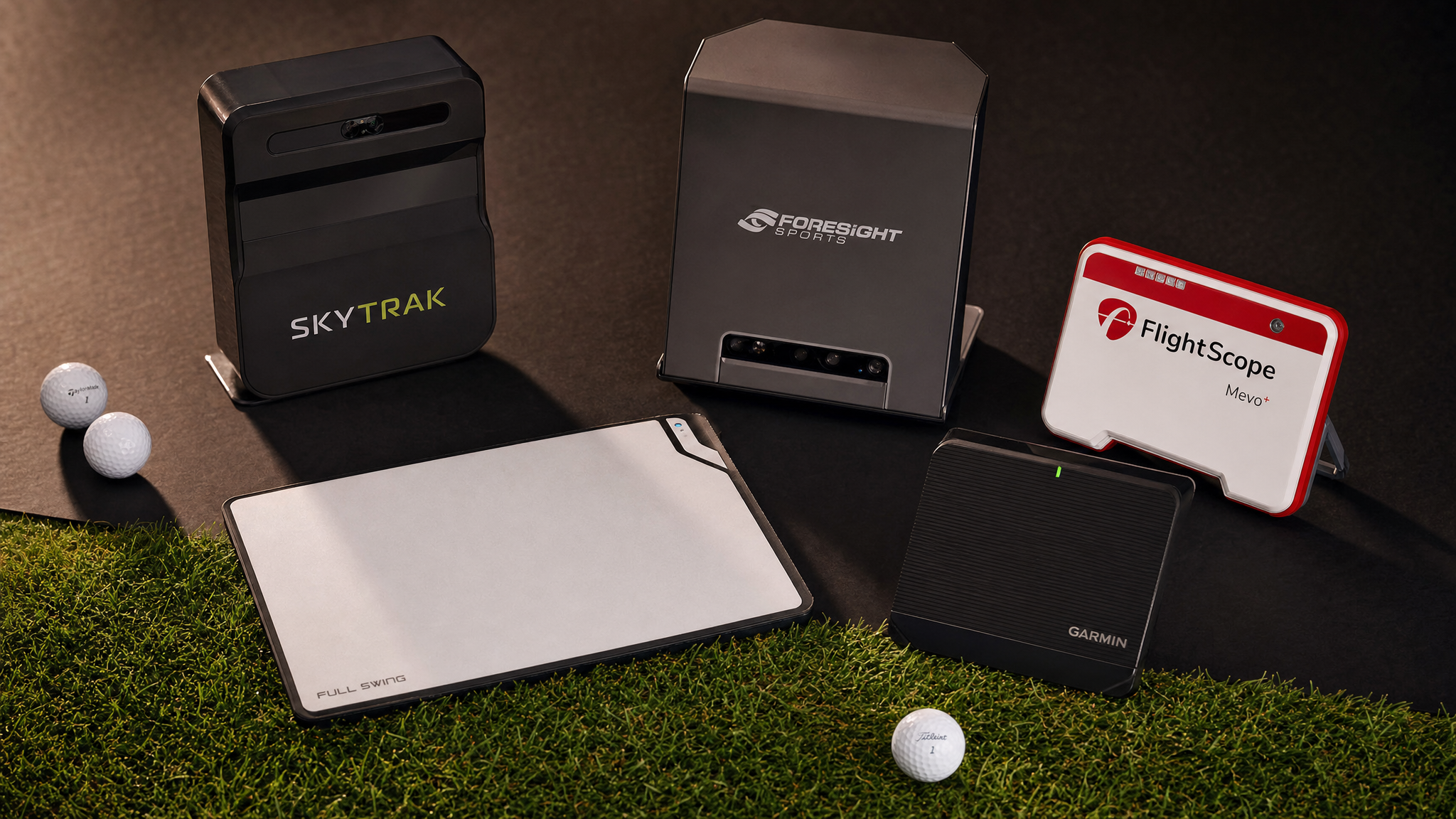
Buying Guide
The 5 Best Golf Simulators in 2024 (After Testing Them All)
A golf simulator is not an impulse buy. The cheapest decent setup costs more than a season of range time. A proper indoor system can run $15,000 all-in before you add the enclosure, projector, and decent flooring. So before you spend anything, you should know exactly what you're getting — what the technology actually does, where each system falls short, and which one is right for how you actually play and practice.
I've spent time with all five systems below. Here's what I found.
Quick Navigation
1. SkyTrak+
Best for: Home simulators, indoor practice rooms, serious amateur golfers
The SkyTrak+ earns the "best overall" label because it threads the needle most people actually care about: good enough accuracy for meaningful practice, enough software compatibility to make it a real simulator, and a price that doesn't require a second mortgage.
The camera-radar hybrid approach — combining photometric image capture with radar data — gives the SkyTrak+ an edge over pure radar units at this price point. You get 8 shot metrics including club speed, ball speed, launch angle, spin rate, spin axis, side spin, vertical launch angle, and horizontal launch angle. That's genuinely useful data, not just ball speed and carry distance.
What it does well: Software compatibility is excellent. Works with E6 Connect, TGC2 (The Golf Club 2019), WGT, and SkyTrak's own app. The E6 Connect library alone gives you access to over 100,000 course holes. For a home setup where you want to actually play golf, not just hit balls into a net, this matters a lot.
What it doesn't do well: The SkyTrak+ is sensitive to lighting conditions. Camera-based systems live and die by consistent, diffused lighting — put it in a garage with windows and afternoon sun, and your data will suffer. It also needs at least a 10x10 foot hitting area minimum, and outdoor use is limited. If you want to use it at the driving range, look elsewhere.
Software and subscriptions: The subscription situation is real. The $99/year Practice plan covers basic practice modes. The $199/year Full Simulator plan unlocks E6 Connect, TGC2, and full game modes. Budget accordingly — this is part of the total cost of ownership.
Who should buy it: Anyone building a dedicated indoor simulator space on a reasonable budget. Home theater basement setups, converted garages with good lighting control, dedicated rooms. If you want one system that does everything well for a home setup under $10,000 all-in, the SkyTrak+ is the answer.
Who should skip it: Outdoor users, people in variable-lighting environments, anyone who needs to travel with their launch monitor. Radar wins for portability and outdoor use.
2. Foresight Sports GC3
Best for: Dedicated simulator rooms, club fitters, serious players who demand accuracy
The GC3 is built on Foresight's proven camera technology — three high-speed cameras that capture ball data in the millisecond after impact. The result is the kind of accuracy that club fitters and teaching professionals rely on for actual fitting sessions, not just practice entertainment.
It's essentially the GCQuad's younger sibling. The GCQuad at $15,000+ is what you find in premium golf stores and on Tour. The GC3 gives you around 90% of that accuracy at less than half the price. That still makes it expensive in the consumer space, but the data quality justifies it for serious golfers.
What it does well: Indoor accuracy is exceptional. Ball speed, launch angle, spin rate, spin axis — all measured directly from high-speed camera footage, not calculated or estimated. For iron shots especially, the GC3 is in a different accuracy tier from radar-based systems. No subscription required for basic ball tracking, which is a genuine differentiator at this price.
What it doesn't do well: It's fundamentally an indoor system. Camera-based tracking doesn't love outdoor conditions — bright sunlight washes out the image. Club data is less detailed than some radar systems because cameras don't track the club as naturally as radar. The FSX Live software, while functional, feels a bit dated compared to newer platforms.
Software: FSX Live is Foresight's own platform. Basic ball tracking is included. Full simulator features with course play run about $150+/year. E6 Connect also works with the GC3.
Who should buy it: Golfers with a dedicated indoor simulator room who prioritize accuracy above all else. Club fitters, teaching professionals, or anyone who wants to know they're getting real data, not good data.
Who should skip it: Outdoor practitioners, garage setups with variable lighting, anyone trying to build a complete setup for under $10,000 — the GC3 alone chews most of that budget.
3. Full Swing KIT
Best for: Outdoor practice areas, range setups, dual indoor/outdoor use
Full Swing has built a legitimate reputation — they make the full simulator systems you find in high-end hotels and corporate entertainment spaces. The KIT is their consumer-facing portable unit, and it carries the same dual-radar technology from their commercial lineup.
Yes, Tiger Woods has one in his garage. That's true and it's worth mentioning — but only because it reflects something real about the product. Full Swing has genuinely earned that relationship. The dual-radar system tracks both ball and club with the kind of data fidelity that justifies the professional endorsement, not just the price tag.
What it does well: Outdoor performance in full daylight is where the KIT separates itself. Radar doesn't care about sunlight. Camera systems struggle in bright outdoor conditions; the KIT doesn't. If you want a range setup that works summer afternoons in Florida, this is basically your only serious option at this price tier.
What it doesn't do well: At $6,999, you're paying a premium for the brand and the outdoor capability. Pure indoor accuracy compared to the GC3 — a camera system purpose-built for that environment — the GC3 edges it out. The software ecosystem is narrower than SkyTrak+ in terms of third-party integrations.
Software: Full Swing's own platform is polished and professional. Course library is solid. It doesn't have the breadth of E6 Connect, but what's there is high quality.
Who should buy it: Golfers with outdoor practice areas, dedicated range setups, or anyone who specifically needs a launch monitor that works equally well inside and outside. Also the right pick if brand quality and support matter to you.
Who should skip it: Pure indoor users who want maximum accuracy per dollar — the GC3 beats it on that metric. And if $7,000 is your total budget (launch monitor + enclosure + screen + projector), the SkyTrak+ gives you more system for less money.
4. FlightScope Mevo+
Best for: Range use, outdoor practice, golfers who move between locations
The Mevo+ is where the portability argument gets real. It's a Doppler radar unit that fits in a bag, works outdoors without issue, and at $2,199, occupies a price tier that doesn't feel absurdly out of reach for a serious amateur.
FlightScope has been in the professional launch monitor business for decades — their technology shows up in serious club fitting environments. The Mevo+ is the consumer version of that expertise, and it shows in the data quality.
What it does well: Doppler radar works equally well indoors and out. The data set is comprehensive — with the Essential subscription ($150/year), you get 16+ shot metrics and full simulator mode through E6 Connect. The portability is genuine: take it to the range, put it in your garage, travel with it. The SkyTrak+ can't do that.
What it doesn't do well: The 8-foot requirement behind the ball is a real constraint. Many garage setups can't accommodate it without significant rearrangement. Spin data accuracy, while good, doesn't quite reach camera-system territory — radar calculates spin rather than measuring it directly, which matters for wedge shots and short game work.
Software: E6 Connect integration is solid. The Essential plan at $150/year unlocks simulator mode, E6 course play, and full data metrics. Without the subscription, you get basic data only.
Who should buy it: Range regulars, golfers who practice outdoors, anyone who needs portability. Also a strong option if you split time between locations and can't have a permanent setup.
Who should skip it: Small garage setups where 8 feet behind the ball isn't possible. Pure indoor users who prioritize spin accuracy — spend more for the GC3 or go with the SkyTrak+.
5. Garmin Approach R10
Best for: Beginners, budget-conscious golfers, first simulator experiences
Here's the thing about the Garmin R10: it's $599 and it actually works. Not "works for the price" in a patronizing way — it genuinely provides useful data that will help you improve your game.
Is it the same as a $3,000 SkyTrak+? Of course not. The accuracy ceiling is lower. The spin data is estimated rather than measured. You need a smartphone for full functionality. But if your budget is under $1,000 and you want to try simulator golf, the R10 is the right starting point.
What it does well: 16 ball metrics for $599 is genuinely impressive. Ball speed, launch angle, spin rate, shot shape, carry distance — all there. E6 Connect support means you can play real courses. Garmin's Garmin Golf app integration is polished and works reliably. It's also genuinely portable in a way larger units aren't.
What it doesn't do well: Radar-only means spin data is calculated, not measured — accuracy on wedge shots and anything with heavy spin is noticeably lower than camera systems. Outdoor use only (radar needs space). You need your phone for full simulator features. The E6 subscription costs extra on top of the unit price.
Software: Garmin Golf app is required. E6 Connect works but requires its own subscription. The combination is functional, not seamless.
Who should buy it: Beginners who want to try simulator golf before committing. Anyone with a budget under $1,000. Golfers who want useful practice data without the infrastructure investment.
Who should skip it: Anyone who's serious about accuracy for fitting or serious game improvement work. Treat this as a gateway drug to the hobby, not a long-term destination.
Quick Comparison
| Simulator | Price | Technology | Accuracy | Subscription | Best Use |
|---|---|---|---|---|---|
| SkyTrak+ | $2,995 | Camera + Radar | ★★★★☆ | $99–199/yr | Indoor home |
| Foresight GC3 | $6,999 | 3-Camera | ★★★★★ | None (basic) | Indoor accuracy |
| Full Swing KIT | $6,999 | Dual Radar | ★★★★☆ | Included | Outdoor/range |
| Mevo+ | $2,199 | Doppler Radar | ★★★☆☆ | $150/yr full | Portable/range |
| Garmin R10 | $599 | Radar | ★★★☆☆ | App req. | Budget entry |
How to Choose: The Real Questions
Radar vs. Camera: The Core Tradeoff
Radar tracks the ball by bouncing radio waves off it in flight. It's fast, works in any lighting, works outdoors, and is generally more portable. The tradeoff: spin data is often calculated rather than directly measured, which means accuracy on high-spin shots (wedges, draws, fades) is lower than camera systems.
Camera systems photograph the ball at impact and in early flight, measuring the actual dimple pattern to determine spin axis and rate. This is more accurate, but cameras need good, consistent lighting — and they struggle outdoors in bright sunlight. They're also generally not portable in any meaningful sense.
The SkyTrak+ hybrid approach — both camera and radar — is the most interesting answer to this tradeoff at the consumer level.
Indoor vs. Outdoor
If you're building an indoor simulator room, camera systems (GC3, SkyTrak+) are the better choice. If you want outdoor use or a range setup, go radar (KIT, Mevo+, R10). If you need both, the Full Swing KIT is the most serious answer — or accept that you'll be buying something that does one thing excellently and the other thing adequately.
Software Matters as Much as Hardware
This is the thing most buying guides underplay. A launch monitor is just a data collection device. The software is what turns it into a simulator — and the difference between a good software experience and a bad one is enormous. E6 Connect is the gold standard for course variety. TGC2 (included with APOGEE) is the best standalone experience. Full Swing's software is polished. Foresight's FSX Live is functional but feels dated.
Factor software costs into your budget. A SkyTrak+ at $2,995 plus E6 Connect at $199/year is more than a $3,000 purchase over two years.
Space Requirements
Minimum viable indoor setup: 10 feet wide, 10 feet deep, 9 feet ceiling. That's tight. Comfortable: 12 feet wide, 15 feet deep, 10+ feet ceiling. The SkyTrak+ needs 10x10 minimum. The Mevo+ needs 8 feet behind the ball, which is a different constraint. The R10 is more forgiving on space.
Measure your space before buying. Ceiling height matters more than floor space — a low ceiling is an immediate disqualifier. See our garage setup guide for detailed measurements.
What Budget Tier Actually Makes Sense?
Under $1,000 (Garmin R10 tier): Great for trying it out, basic practice data, casual use. Accept the accuracy limitations.
$2,000–$3,500 (SkyTrak+, Mevo+ tier): Serious amateur use. Enough accuracy to meaningfully improve your game. The sweet spot for most golfers.
$6,000–$9,000 (GC3, Full Swing KIT, APOGEE tier): Professional-grade accuracy or a complete turnkey system. Justified if accuracy is critical or you want something that just works perfectly.
Remember: the launch monitor is just one part of the total system cost. Add enclosure, impact screen, projector, hitting mat, and software for the real number. See our under $5,000 guide for complete system breakdowns.
The Bottom Line
For most people building a home simulator: SkyTrak+. It hits the right balance of accuracy, software ecosystem, and price without requiring you to sacrifice any one thing too severely.
If accuracy is your North Star: Foresight GC3. You'll pay for it, but the data is real.
If you're primarily outdoors: Full Swing KIT. Nothing else performs like this in daylight.
If $600 is your budget: Garmin R10. It works. Start there.