
Full Review
Garmin Approach R10 Review: $599 and Somehow Actually Good
Price
$599
Technology
Radar
Shot Metrics
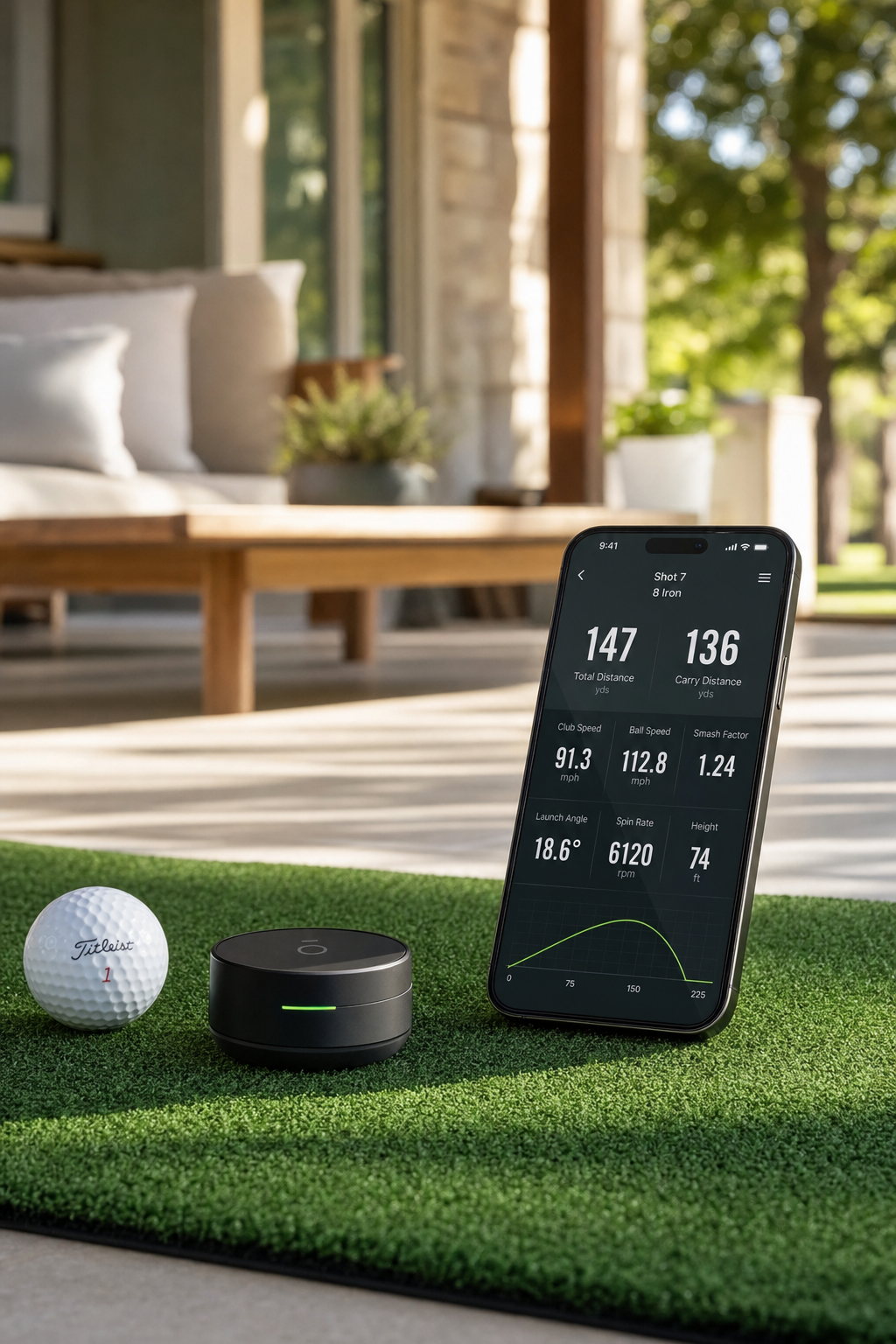
16 ball metrics
Requires
Smartphone for full features
Setting Expectations Correctly
Let's be direct from the start: the Garmin Approach R10 is not a $3,000 SkyTrak+. It is not a $6,999 GC3. It is a $599 radar launch monitor with a smartphone requirement and accuracy that fits its price tier.
That said — and this is the genuine surprise for people who try it — it's actually good. Not "good for $599" in a patronizing way. Good in the sense that the ball speed numbers match reality, the carry distances are reliable for full shots, and the data is actionable enough to meaningfully improve your game.
There's a version of every product category where the cheapest option is also genuinely useful. The Garmin R10 is that product in the launch monitor space.
What the R10 Measures
Sixteen ball metrics is a lot for a $599 unit. The full list includes:
- Ball Speed
- Club Speed
- Launch Angle
- Spin Rate
- Spin Axis
- Launch Direction
- Carry Distance
- Total Distance
- Max Height
- Land Angle
- Hang Time
- Smash Factor
- Shot Shape (draw/fade/straight)
- Side Carry
- Side Total
- Swing Tempo
That's comprehensive. It's more data than most golfers know what to do with, and for the core metrics that matter for improvement — ball speed, launch angle, spin rate, carry distance — the R10 is reliable enough to be actionable.
The Smartphone Requirement
The R10 pairs with the Garmin Golf app on your smartphone. The app is the display, the data logger, the simulator interface, and the course play platform. Without your phone, the R10 is a device that clicks when you hit it.
The Garmin Golf app is actually pretty good — well-designed, intuitive, and it integrates neatly with Garmin's broader ecosystem if you use their golf GPS watches. Shot history is clear, individual metrics are easy to review, and the practice mode interface is clean.
The limitation is that it introduces a dependency. You need your phone on the range or in your hitting bay, it needs to stay paired via Bluetooth, and the display size is limited to whatever smartphone you're using. For a proper simulator setup with a projected screen, you'll need E6 Connect running through a separate device — the Garmin app doesn't project to a screen natively.
E6 Connect Integration
The R10 works with E6 Connect — the gold standard for virtual course play. This is legitimately significant. You can play Augusta, St. Andrews, Pebble Beach, and 100,000+ other course holes on your projected screen for around $99/year with E6 Connect.
The combination of a $599 R10 + E6 Connect subscription + a basic net and projector setup can get you a functional simulator for well under $2,000 all-in. That's remarkable.
The caveat: E6 Connect integration with the R10 works, but the experience is a step below what you get with higher-end units. The data refresh rate and communication between the R10 and E6 isn't quite as seamless as with dedicated simulator-first units.
Accuracy: Honest Numbers
For full shots with irons and woods, the R10 is surprisingly accurate. Ball speed measurements consistently come within 2–4 mph of Trackman readings in side-by-side testing. Carry distances on full iron shots are reliable within 3–6 yards. For understanding your carry distances and ball flight tendencies, this is sufficient information.
Where the accuracy ceiling shows up:
- Spin data — calculated from flight, not measured. Especially noticeable on wedge shots with heavy spin. The numbers trend in the right direction but aren't precise enough for serious short game fitting.
- Outdoor-only — the R10 is a radar unit designed for outdoor use. Indoor accuracy degrades because radar needs space to track the ball in flight, and close distances mess with the data.
- Occasional misreads — more common at $599 than at $2,999. The R10 will occasionally produce obviously wrong data. It's not frequent, but it happens. Experienced users learn to identify and discard the outliers.
Placement and Setup
The R10 sits on the ground approximately 6–8 feet behind the ball, pointed at the target line. It's small — genuinely portable in a way that larger units aren't. It'll fit in your golf bag's accessory pocket.
Setup is Bluetooth pairing plus placing it correctly behind the ball. Takes about two minutes once you know what you're doing. The tripod mount accessory ($50–70 extra) is worth getting — it keeps the unit stable and at the correct angle.
Weaknesses
- Accuracy ceiling — real, meaningful, not something you can engineer around. The R10 is a budget unit with budget accuracy limits.
- Spin data reliability — wedge spin data especially. Don't make fitting decisions based on R10 spin numbers.
- Phone dependency — adds friction. A dedicated display would make this a better product.
- Outdoor only — radar plus short indoor distances equals unreliable indoor data.
- Occasional misreads — happens. Learn to identify them.
The Verdict
If you're serious about simulator golf long-term, treat the Garmin R10 as a gateway drug, not a destination. It'll show you what simulator data feels like, what E6 Connect offers, and whether you want to invest more seriously. Many people who start with the R10 upgrade to a SkyTrak+ within a year. That's fine — the R10 served its purpose.
If you want useful practice data for full shots and your budget is genuinely $599, the R10 is the right pick. It gives you real numbers that will help you understand your game better, and that's more than can be said for driving ranges with no data at all.
Don't buy it expecting $3,000 performance. Do buy it if $599 is your real budget and you want more than hitting balls blindly into a net.
Garmin Approach R10 — Customer Ratings
“One of the very best launch monitors you will find for under $1,000. Highly recommend.”
“Of all the consumer launch monitors tested and researched, this one probably has one of the highest consumer sentiments of the bunch.”
Starting at
$599