
Buyer's Guide
Best Golf Hitting Mats: I Destroyed My First One in 8 Months
I destroyed my first mat in 8 months. Here's what I wish I'd bought instead.
It was a $79 hitting mat I found on Amazon, 4 × 5 feet of synthetic turf over a thin rubber base. By month three, the fiber was matted down and shredding in the strike zone. By month six, I was hitting off essentially bare rubber. By month eight, I threw it out. The replacement cost nearly wiped out the savings versus buying a quality mat to begin with.
That's the core lesson in this guide: hitting mat quality directly affects your wrists, your technique feedback, and your long-term enjoyment of home golf practice. You can't phone this one in and expect good results. Here's what I know now after going through four mats and spending real time comparing them side by side.
Why Mat Quality Matters — Wrist Health and Lie Angle Feedback
The Wrist Injury Risk Is Real
On real turf, a fat shot digs into the ground and the club decelerates through soft material. On a thin hitting mat, a fat shot hits a hard surface with no give. The club bounces, the shaft torques, and that shock travels directly into your wrists, forearms, and elbows.
This is not theoretical. Golfer's elbow (medial epicondylitis) and wrist tendinitis are meaningfully more common among players who practice heavily on cheap mats versus quality mats or real turf. A mat with proper cushioning and shock absorption dramatically reduces this risk. It's not about feel — it's about not injuring yourself during what should be fun practice.
Lie Angle Feedback
Good mats give you honest feedback on where the club is contacting the ground. Fat shots feel different from clean strikes, and thin shots feel different from divot shots. Cheap mats, especially matted-down synthetic turf, homogenize all of this — every shot feels roughly the same, clean or not, because the surface has no give and the fibers don't respond to the club.
If you're trying to improve your ball-striking by practicing at home, you need a mat that tells you something. A mat that feels the same whether you're hitting behind the ball or catching it clean is actively working against your improvement.
Thickness Guide: What the Numbers Mean
Hitting mats are typically described by their total thickness — the combined height of the hitting surface and the base. Here's what the spec sheet numbers actually mean in practice:
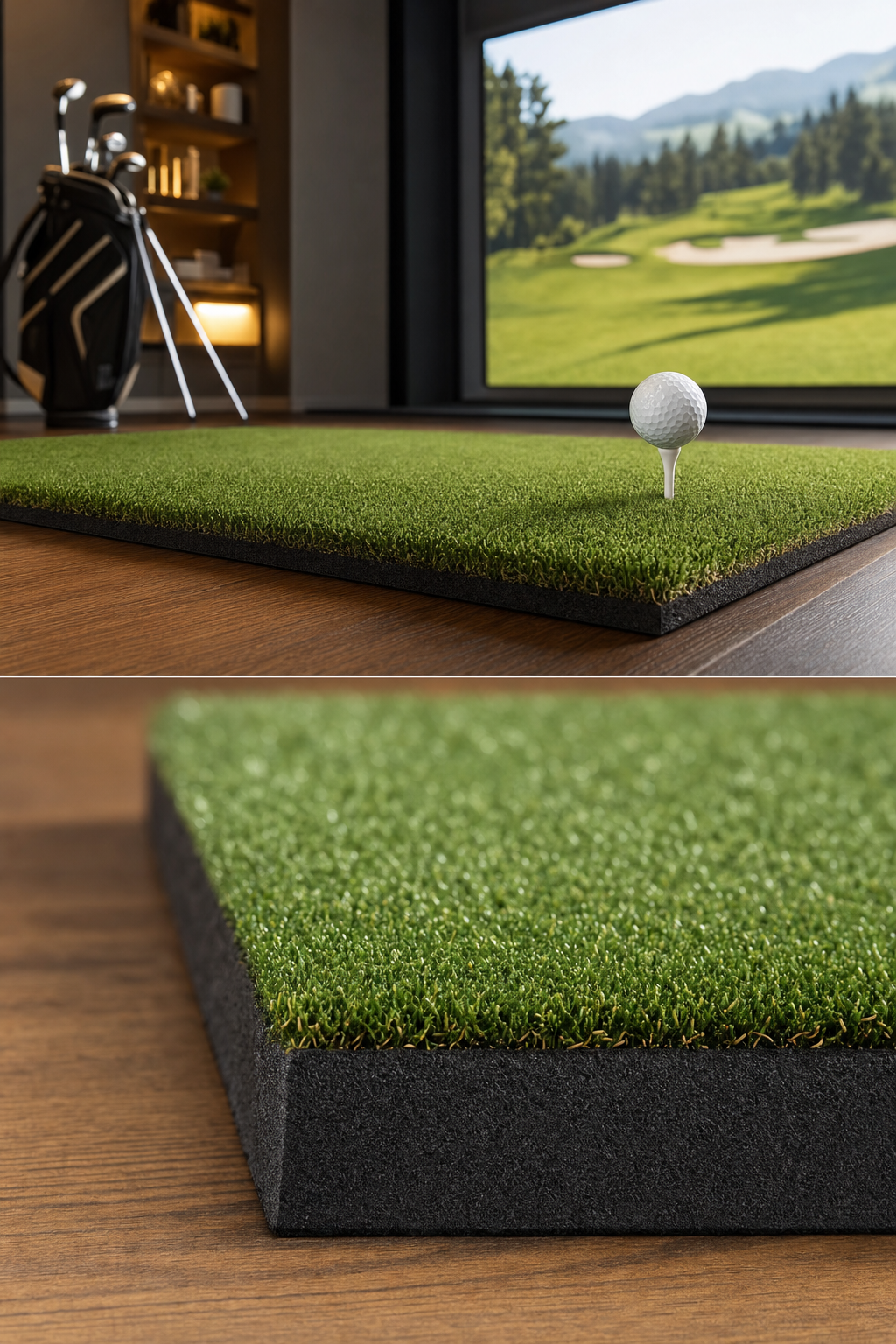
- Under 1 inch total: Avoid. No meaningful shock absorption. Hard surface beneath the fiber layer. The cheapest mats live here.
- 1–1.5 inches: Acceptable for casual use. Better budget mats. Some shock absorption but limited. Fine for putting and chip practice; not ideal for full swing sessions.
- 1.5–2.5 inches: The right zone for serious home practice. Enough material for genuine shock absorption, meaningful feedback, and real durability. Quality mid-range mats live here.
- 2.5 inches+: Premium territory. Gel systems, foam underlayers, replaceable hitting inserts. Best shock absorption, longest longevity, highest cost.
Hitting Surface vs. Base: Two Different Problems
The hitting surface and the base layer are two distinct engineering problems that cheap mats treat as one. Here's why they're different:
Hitting surface: Needs to simulate turf interaction — some give under the club, consistent lie angle, clear feedback on mis-hits. The surface fiber density, fiber type (nylon vs. polypropylene), and surface cut angle all matter here. Premium mats use longer, denser fibers with realistic lie angles. Budget mats use short, uniform AstroTurf-style fiber that shows wear quickly.
Base layer: Needs to absorb shock and stay stable. The base has to prevent the mat from sliding (on any surface), cushion the impact to protect your joints, and maintain its shape over time. Cheap mats use thin rubber that compresses permanently over time and provides minimal shock absorption. Quality mats use thick urethane foam, multi-density rubber, or purpose-built foam systems that maintain their properties for years.
When evaluating a mat, ask separately: how good is the hitting surface, and how good is the base? Sometimes a mat has a better surface with a mediocre base (common in mid-range) or vice versa. The best mats excel at both.
Portable vs. Permanent Setups
This is a real setup decision that affects which mat makes sense:
Permanent setup: The mat lives in one place, doesn't need to be moved, and can be larger and heavier. Here you can go bigger — 5×5 or even 4×7 mats give you more hitting variety and look better in the space. Weight doesn't matter. Size does.
Portable setup: The mat needs to move — garage setup that shares space with a car, a mat that goes to the range or a friend's house. Here you want lighter materials, a manageable size (4×4 maximum for easy carrying), and a base that doesn't grip the floor permanently. Some mats are designed specifically for portability; others will beat you up carrying them repeatedly.
The Best Golf Hitting Mats: Our Picks
Fiberbuilt Flight Deck — The Gold Standard
Price Range
$399–$799
Key Feature
Replaceable divot channel
Best For
Permanent setups, serious practice
Fiberbuilt is the benchmark that everything else gets measured against. Their Flight Deck system uses a unique construction: a dense, high-fiber-count hitting surface over a thick foam base, with a removable and replaceable divot channel insert in the center strike zone.
That replaceable divot channel is the key innovation. Instead of waiting for the entire mat surface to wear out, you replace only the strike zone insert when it shows wear — typically after 12–18 months of heavy use. The base and surrounding surface remain intact. Total long-term cost of ownership is actually competitive with cheaper mats because you're replacing $50–$100 inserts rather than $400 mats.
Feel: the best of any mat at this price point. The fiber density and height accurately simulate fairway turf. Fat shots feel unmistakably like fat shots. Clean strikes feel genuinely clean. It gives feedback without punishing your wrists. After using the Flight Deck, going back to a budget mat feels like hitting off a sidewalk.
TrueStrike Golf Mat — Gel Divot System, Realistic Feel
Price Range
$249–$499
Key Feature
Gel divot system
Best For
Realistic turf simulation
TrueStrike's gel divot system is genuinely clever. The center of the mat uses a gel-filled insert beneath a synthetic turf surface. When the club strikes the mat — clean or fat — the gel compresses slightly and returns, mimicking the way a real fairway gives under club contact. It's the closest to real turf feel of any mat in this price range.
Wrist impact is measurably better than standard mats. The gel layer absorbs club bounce energy effectively, which reduces the shock that would otherwise travel up the shaft. Golfers recovering from wrist or elbow issues who still want to practice full swings should consider TrueStrike specifically for this reason.
The gel insert does wear out eventually — TrueStrike sells replacement inserts — but the base mat lasts significantly longer than budget options. The hitting surface fiber is high quality and holds up well under repeated use.
SIGPRO Softy — Best Value, Thick Synthetic Turf
Price Range
$179–$349
Key Feature
Thick synthetic turf, forgiving base
Best For
Value-conscious buyers
SIGPRO's Softy mat punches significantly above its price point. The hitting surface uses a longer, denser synthetic fiber than typical budget mats — closer to fairway turf height, which means the club interacts with it more realistically. The base is a thick rubber compound that provides genuine shock absorption without the heel-toe bounce of thin rubber mats.
If you're spending under $350 on a hitting mat and you want something that will genuinely serve you for 18+ months of regular use, the SIGPRO Softy is the answer. It won't match the Fiberbuilt or TrueStrike in feel or durability, but the gap is smaller than the price difference suggests.
Good for: golfers building their first real simulator setup on a budget, players who practice 2–3 times per week, and anyone who wants to try a quality mat without the premium price to decide if it matters to them before committing to Fiberbuilt pricing.
Country Club Elite — Urethane Foam Base, Premium Cushion
Price Range
$299–$599
Key Feature
Urethane foam base
Best For
Joint-conscious golfers
Real Feel Golf Mats' Country Club Elite uses a urethane foam base layer rather than the standard rubber used in most mats. Urethane foam has superior shock absorption characteristics compared to rubber — it compresses more uniformly and returns more slowly, which translates to significantly less club bounce and wrist impact.
The hitting surface uses a proprietary synthetic grass that runs longer than typical materials. Visually it looks closest to real fairway grass of any mat in this guide. The lie angle feedback is accurate: thin shots feel thin, fat shots register clearly, clean contact feels genuinely clean.
Where Country Club Elite stands out: golfers with joint sensitivities or who are managing existing wrist or elbow issues will find the urethane foam base the most forgiving option available at this price. It's worth considering specifically if wrist health is a concern alongside general mat performance.
Side-by-Side Comparison
| Mat | Price | Wrist Safety | Turf Feel | Longevity |
|---|---|---|---|---|
| Fiberbuilt | $399–$799 | Excellent | Best in class | 5+ yrs (replaceable) |
| TrueStrike | $249–$499 | Excellent (gel) | Very realistic | 3–4 yrs |
| SIGPRO Softy | $179–$349 | Good | Good | 2–3 yrs |
| Country Club Elite | $299–$599 | Excellent (foam) | Very realistic | 3–5 yrs |
Pairing Your Mat With the Right Launch Monitor
The mat is the practice surface; the launch monitor is what turns your swings into data. If you're building a complete home setup, these are the monitors that pair most naturally with a quality hitting mat:
- SkyTrak+ ($2,995) — placed to the side of the mat, no rear clearance needed. Works perfectly with any permanent mat setup.
- FlightScope Mevo+ ($2,199) — requires 8 ft behind the ball. Make sure your mat placement leaves enough room behind you.
- Garmin R10 ($599) — the entry-level option that works anywhere you have space, portable and easy to position.
The Bottom Line
The mat you practice on has a more direct effect on your wrist health and shot feedback quality than almost any other component of your home simulator setup. A bad mat costs you feedback you can't improve without. A good mat makes every session more informative and protects you from repetitive stress injuries that can sideline your golf entirely.
Spend at least $200 on a mat if you're practicing regularly. For serious golfers who hit daily, the Fiberbuilt Flight Deck is the only mat I'd recommend without reservations. For budget-conscious builders, the SIGPRO Softy is genuinely good at its price. And if wrist protection is your primary concern, TrueStrike's gel system or the Country Club Elite foam base are purpose-built for exactly that.
You'll hit a lot of balls on this mat. Buy one that earns them.