
Full Review
Foresight GC3 Review: Tour-Level Accuracy for Serious Golfers
Price
$6,999
Technology
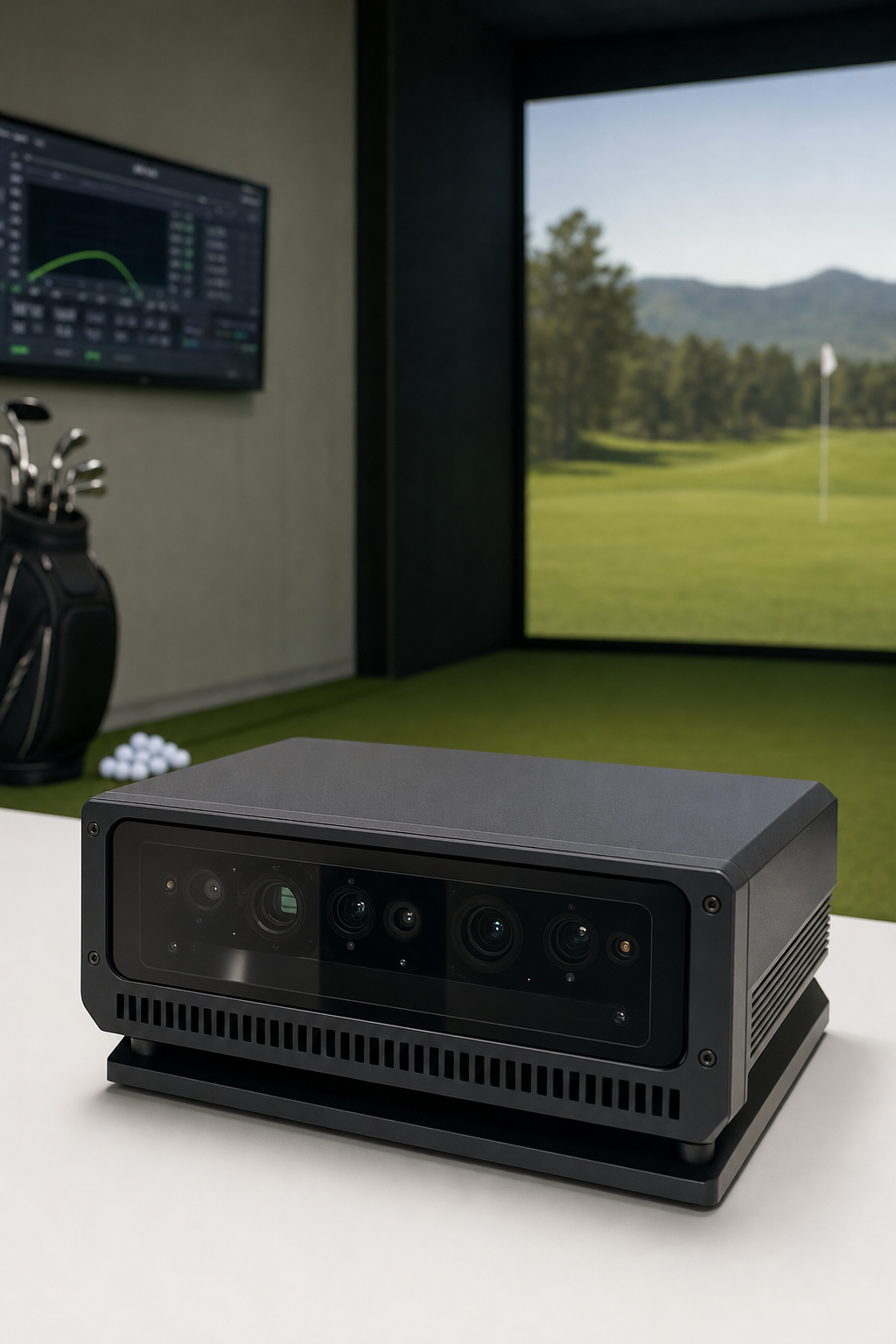
3-Camera System
Base Subscription
None for basic use
Best Use
Indoor dedicated rooms
The Foresight Pedigree
Before we get into the GC3 specifically, it's worth understanding where it comes from. Foresight Sports makes the GCQuad — the $15,000+ launch monitor you find in premium club fitting studios, on the PGA Tour, and in high-end retail fitting bays. When serious fitters need data they can stake their professional reputation on, they use Foresight cameras.
The GC3 is the next step down from the GCQuad. It uses three cameras instead of four, which gives up some club data precision while retaining essentially the same ball tracking accuracy. If the GCQuad is the reference standard, the GC3 is the version you can actually afford without selling a car.
How Three Cameras Change Everything
The fundamental difference between camera-based tracking and radar tracking is what's actually measured versus what's calculated. Radar systems measure ball flight and calculate spin from the flight characteristics. Camera systems photograph the ball in the milliseconds after impact and measure the actual rotation of the ball's dimple pattern.
This is a meaningful distinction. When you hit a high-spinning wedge shot that curves sharply — a tight draw or a hard cut — radar is essentially guessing at spin axis from flight path data. Cameras see the actual ball rotation. The result is that camera systems, and the GC3 in particular, are significantly more accurate on short game shots, specialty shots, and anything with unusual spin patterns.
For a serious golfer who cares about the short game, this isn't academic. Wedge spin rates and launch angles from a GC3 are data you can trust. From a radar unit, they're estimates you need to treat with more skepticism.
The No-Subscription Differentiator
Here's something that doesn't get enough attention in GC3 coverage: basic ball tracking data requires no subscription. You plug it in, connect to FSX Live, and the ball flight data is just... there. No $199/year gate before the device does what it's supposed to do.
This matters because at $6,999, you've already made a significant commitment. The SkyTrak+ at $2,995 then asking for $199/year for simulator access feels proportionally more frustrating than the GC3's approach. Full simulator features with course play do require an FSX Live subscription — around $150+ per year — but the core functionality works on day one without anything extra.
FSX Live Software
Foresight's own software platform is FSX Live, and the honest review here is mixed. The functionality is comprehensive — it connects to Foresight's cloud system, offers course play, practice modes, and detailed shot history. The course library is solid.
The interface feels like it was designed around 2018 and hasn't had a complete visual overhaul since. It works, and the data presentation is excellent (Foresight knows data), but next to something like Full Swing's software or TGC2, it looks dated. If software experience is a major factor for you, know going in that FSX Live is functional, not beautiful.
E6 Connect also works with the GC3, which is the alternative for anyone who prioritizes course variety and interface quality over the native Foresight experience.
Indoor Performance: Exceptional
In a dedicated indoor environment with controlled lighting, the GC3 is simply the most accurate consumer launch monitor you can buy for under $10,000. Ball speed within 0.5–1 mph of Trackman in side-by-side testing, spin rates that match GCQuad readings, launch angles that nail reality.
This level of accuracy matters if you're using it for club fitting decisions, adjusting your swing based on data, or tracking meaningful improvement over time. You're making decisions based on real numbers, not estimates with wider error bars.
Outdoor Use: Not Its Strength
Cameras struggle outdoors. This is a physics problem, not a GC3 problem — high-speed cameras trying to capture ball rotation against a backdrop of variable sunlight, shadows, and wind-blown grass simply don't perform as consistently as they do in a controlled indoor environment.
The GC3 works outdoors, technically. But if outdoor use is a meaningful part of your use case, the Full Swing KIT or FlightScope Mevo+ are better choices. Radar doesn't care about sunlight.
Club Data: Good, Not Perfect
The GC3 with three cameras captures good club data — club speed, dynamic loft, face angle, attack angle. Compared to the four-camera GCQuad, you lose some precision on club path and face closure rate measurements. Compared to dual-radar systems, the club tracking picture is less complete.
For most use cases, this is fine. You're getting all the data you need to understand what the club is doing at impact. For highly technical fitting work where every club data nuance matters, the GCQuad is the right tool — but that's a $15,000 conversation.
Weaknesses
- Price — $6,999 for the unit alone. A complete setup with enclosure, screen, and projector will run $12,000–15,000 all-in. This is a real commitment.
- Outdoor limitations — cameras versus daylight is a losing battle. This is an indoor unit.
- FSX Live interface — functional but dated. Use E6 Connect if you care about the experience.
- Club data is good, not best-in-class — for complete club data, the GCQuad or a dual-radar setup does more.
Who Should Buy the GC3
The GC3 is for golfers who are serious enough about the game that data accuracy is the primary criterion — not price, not portability, not software aesthetics. It's for dedicated indoor simulator rooms, for club fitters who want a professional-grade tool at a consumer-accessible price, and for players who want to know with confidence that the numbers they're seeing are real.
If you're spending $12,000+ on a complete indoor setup anyway, spending the $6,999 on the GC3 instead of the $2,995 on the SkyTrak+ is a relatively small premium for meaningfully better ball data. The rest of the system costs are the same.
Who Should Skip It
Anyone with an outdoor or portable use case. Anyone whose total system budget is under $10,000 — the GC3 alone is 70% of that. Anyone who wants a turnkey experience with best-in-class software — the TruGolf APOGEE serves that better. And anyone who primarily wants to play virtual golf for fun rather than serious practice — the SkyTrak+ at $2,995 is plenty good for that, and $4,000 cheaper.
Starting at
$5,999